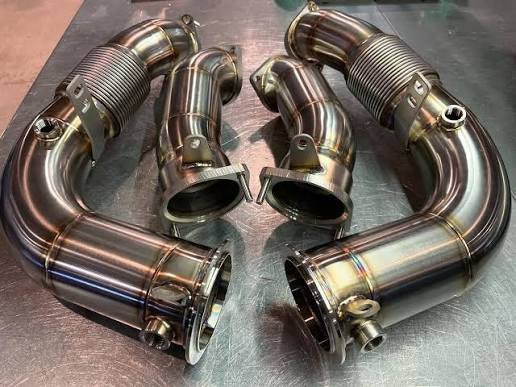
Modern performance cars are engineered to deliver an impressive balance of power, refinement, and everyday usability. Yet for enthusiasts, factory specifications are often only the beginning. Exhaust upgrades are among the most popular modifications because they can change the way a vehicle sounds, responds, and feels under acceleration.
Downpipes are especially important on turbocharged engines because they sit close to the turbocharger and influence how exhaust gases move into the rest of the exhaust system. When properly engineered and matched to the vehicle, a performance downpipe can become a useful component in a broader modification package.
Understanding the Purpose of Downpipes
A downpipe carries exhaust gases away from the turbocharger. Because this area experiences high temperatures and substantial exhaust pressure, its design can have an effect on exhaust flow and turbocharger behavior.
Factory components are designed to satisfy multiple requirements, including emissions regulations, noise limits, durability, and comfortable daily driving. Performance-oriented alternatives may use different tubing dimensions, smoother bends, and higher-flow components to reduce restrictions.
However, the outcome depends on the entire vehicle configuration. A downpipe should not be viewed as an automatic power upgrade. Supporting modifications, software calibration, fuel quality, and the condition of the engine can all influence the final result.
BMW M5 G90 and G99 Secondary Downpipes
The BMW M5 G90 introduces a new generation of high-performance engineering, while the G99 Touring combines M5 performance with additional practicality. With a sophisticated powertrain and advanced exhaust management, both models offer considerable potential for carefully selected modifications.
For enthusiasts researching bmw m5 g90 g99 secondary downpipes , vehicle-specific fitment is particularly important. Secondary exhaust components must work correctly with the existing exhaust layout, mounting points, sensors, and surrounding hardware.
A quality system should also be manufactured from materials capable of handling repeated high-temperature operation. Precise connections and strong welds can help reduce installation issues and contribute to long-term durability.
Mercedes-AMG GLE 63 S Exhaust Upgrades
The Mercedes-AMG GLE 63 S combines SUV practicality with serious performance. Its turbocharged engine produces strong acceleration while advanced electronics manage everything from power delivery to emissions monitoring.
A properly designed downpipe mercedes gle63s amg setup can alter the vehicle’s exhaust flow and create a more pronounced performance-oriented sound. However, owners should consider the entire exhaust configuration before making a change.
The catalytic-converter configuration is particularly important. Different systems can have different effects on emissions, sound, and engine-management behavior. A road-going GLE 63 S should always be modified with applicable local regulations in mind.
BMW M3 G80 Downpipes
The BMW M3 G80 has become a favorite among performance enthusiasts because it offers strong engine performance while remaining practical enough for everyday use. Its turbocharged powertrain also provides a strong platform for exhaust and tuning modifications.
When selecting bmw m3 g80 downpipes , buyers should focus on accurate fitment, tubing quality, sensor positioning, and compatibility with the rest of the exhaust. A well-designed component should integrate cleanly without unnecessary stress on surrounding parts.
The sound produced by the final setup will depend on the complete exhaust system. Replacing the downpipe while retaining other factory components may create a different result than combining it with a performance mid-pipe or rear exhaust.
Why Material and Construction Matter
Downpipes operate in one of the hottest areas of a performance vehicle. Exhaust temperatures can become extremely high during spirited driving, making material selection and manufacturing quality essential considerations.
Stainless steel is widely used for performance exhaust components because it offers resistance to corrosion and high temperatures. Precise bends can support smoother exhaust flow, while carefully finished welds and mounting points can improve reliability.
Buyers should also avoid assuming that similar engines automatically mean interchangeable components. Modern vehicles can have significant differences in chassis packaging, exhaust routing, sensors, and software.
Tuning and Installation Considerations
Installing a downpipe requires more than simply replacing the factory component. Sensors, brackets, exhaust connections, and heat-management components need to be handled correctly.
Changes to exhaust flow can also affect the vehicle’s engine-management system. Depending on the particular setup, ECU calibration may be required to accommodate modified exhaust characteristics.
Professional installation can help minimize fitment problems and ensure that the finished system is properly secured. It can also provide an opportunity to inspect nearby components that may be affected by heat or vibration.
Checking Road-Use Requirements
Before purchasing a performance downpipe, owners should check the regulations that apply to their vehicle and location. Some exhaust modifications can affect emissions equipment and may not be permitted for public-road use.
This is particularly important when choosing between different catalytic-converter configurations. A component intended for motorsport or off-road applications may not be suitable for a daily-driven vehicle.
Choosing the Right Performance Setup
A good exhaust modification should match the vehicle, driving habits, and overall performance goals. BMW M5 G90/G99 owners may prioritize refined performance, while GLE 63 S and M3 G80 enthusiasts may focus more heavily on sound or supporting engine tuning.
Ultimately, the most important factors are proper fitment, quality construction, appropriate installation, and compatibility with the complete vehicle setup. With careful planning, a well-designed downpipe system can help personalize the driving experience while maintaining the engineering standards expected from modern high-performance vehicles.