Hard water is one of those household problems you can live with for a while, until you suddenly get tired of scrubbing the same white marks from the faucet. Mineral deposits on shower glass, spots on dishes, stiff-feeling laundry, and scale inside water-using appliances can all become part of the daily routine.
The good news is that a traditional water softener uses a fairly straightforward process to reduce hardness. Once you understand what happens inside the system, it becomes easier to see why proper sizing, installation, and maintenance matter.
What Makes Water Hard?
Water hardness primarily comes from naturally occurring calcium and magnesium picked up as water moves through soil and rock. These minerals are dissolved in the water, so they’re usually invisible while you’re filling a glass.
The problems become more noticeable when the water is heated or evaporates. Minerals can remain behind and form scale on fixtures, appliances, and plumbing components.
These hard water minerals can also affect the way soaps and detergents work. Instead of creating a rich lather easily, soap may react with the minerals and leave behind residue.
That doesn’t necessarily mean hard water is dangerous. It simply means the water chemistry can be inconvenient and, over time, contribute to scale-related maintenance issues.
The Resin Tank Does the Heavy Lifting
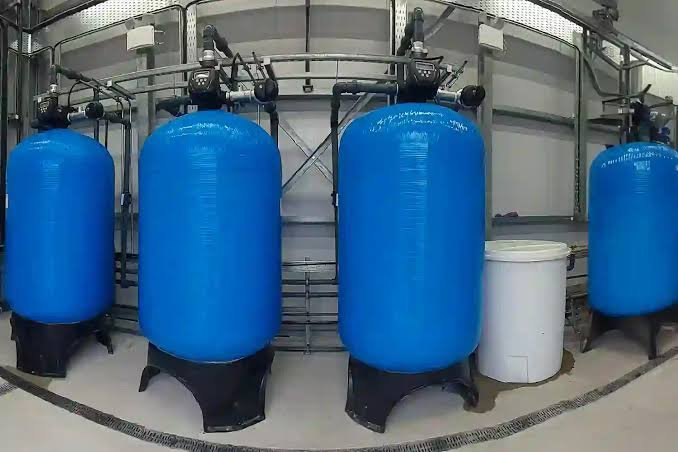
Inside a conventional water softener is a tank filled with tiny resin beads. This component is often called the resin tank, and it plays the central role in the softening process.
As hard water flows through the tank, calcium and magnesium ions attach to the resin beads. At the same time, sodium ions are released into the water.
This process is called ion exchange.
The water continues through the system with significantly less calcium and magnesium hardness. The resin beads, meanwhile, gradually become loaded with the minerals they have captured.
Think of the resin like a collection of tiny parking spaces. At first, plenty of spaces are available for hardness minerals. Eventually, those spaces fill up, and the system needs to regenerate the resin so it can continue working effectively.
What Happens During Regeneration?
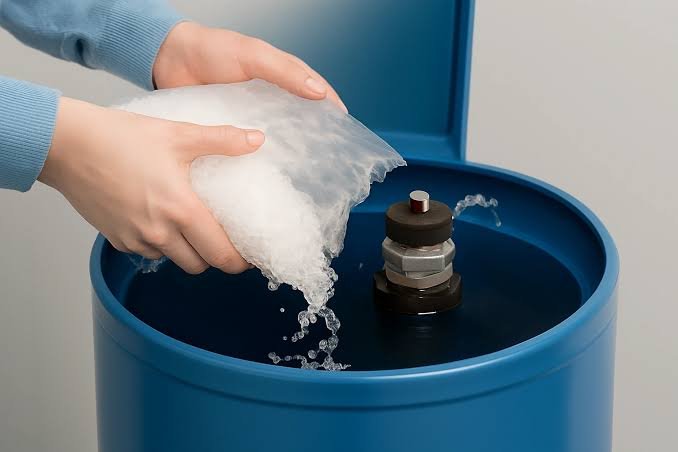
Once the resin reaches its capacity, the softener enters a regeneration cycle. A salt solution is commonly used to flush the hardness minerals from the resin and restore its ability to exchange ions.
The exact regeneration process depends on the system design. Modern softeners may use metered controls that initiate regeneration based on actual water consumption rather than simply running on a fixed schedule.
This can make the system more efficient because regeneration occurs when it’s actually needed.
Of course, regeneration requires water and salt, so efficiency matters when comparing systems. Homeowners should ask about salt consumption, water usage, regeneration settings, and maintenance before choosing a unit.
How Soft Water Enters Your Home
After passing through the softening process, soft water enters your home through the plumbing system and becomes available at the taps and water-using fixtures connected to the treated supply.
This is where the practical benefits become noticeable.
You may see less scale around showerheads and faucets. Glass surfaces can be easier to clean. Soap may lather more readily, and some homeowners notice a different feel on their skin and hair.
Water-using appliances can also experience less exposure to hardness-related scale. That can be helpful for equipment such as water heaters, dishwashers, and washing machines.
However, softened water isn’t the same thing as purified water. A softener is designed primarily to reduce hardness, not to remove every contaminant that might be present in a water supply.
Why Proper Sizing Matters
A softener needs to match the household using it.
A system that’s too small may regenerate frequently and struggle to keep up with periods of heavy water use. An oversized system can cost more than necessary and may not operate as efficiently as a properly sized unit.
Household size, water hardness, daily consumption, peak flow requirements, and plumbing configuration should all be considered.
This is one reason professional water testing and system sizing are worthwhile. The goal isn’t simply to buy the biggest softener available. It’s to install one with enough capacity for your actual needs.
Maintenance Keeps the System Working
Like any mechanical or treatment equipment, a water softener needs some attention.
Salt levels should be checked when applicable, and the system should be inspected periodically. Resin tanks, valves, brine components, and control systems can all require maintenance over time.
If the system isn’t maintained properly, performance may gradually decline. You might start noticing scale returning, changes in water quality, or unusual regeneration behavior.
Routine care is usually much easier than waiting for a complete system failure.
Is Softened Water Right for Every Home?
Not necessarily. Some homes may have water-quality concerns that require additional filtration or purification. Others may prefer alternative scale-control technologies for personal or environmental reasons.
The best approach starts with testing the water and identifying the specific problem you want to solve.
If hardness is the main concern, a properly selected softener can be a practical way to reduce calcium and magnesium, control scale, and make everyday household water easier to manage.
A Simple Process With Everyday Benefits
The science behind water softening may involve ion exchange, resin capacity, regeneration, and water chemistry, but the homeowner’s experience can be much simpler.
Hard water enters the treatment system. The resin captures hardness minerals. The system regenerates when needed. Then treated water continues through the plumbing.
That straightforward process can help reduce the deposits and cleaning frustrations associated with hard water.
Ultimately, the best water softener isn’t necessarily the most complicated one. It’s the system that is correctly matched to your water, installed properly, maintained regularly, and capable of delivering consistent performance for your household.